The B2B buyer who downloads your ebook, joins your nurture sequence, and waits patiently for your sales team to call doesn’t exist anymore. Not in numbers that justify the system built to serve them.
The buyer you’re getting today has already done the research. They’ve consulted an AI, read the Reddit thread, checked G2, scanned your competitors’ positioning, and formed a working opinion about whether you’re worth talking to. They contact you to confirm what they already think, not to start learning.
This changes what your marketing needs to do. At a fundamental level.
The research-first buyer
The research-first buyer is not a new persona. They’re the same B2B decision maker who used to rely on analyst reports, trade publications, and conference conversations to form opinions before engaging vendors. What changed is the speed and accessibility of that research.
A buyer who would have spent three weeks gathering information five years ago now does it in an afternoon. The tools available: AI assistants, peer communities, review platforms. They compress the research timeline and raise the baseline of knowledge buyers arrive with. By the time they contact you, they’ve formed a working hypothesis about your fit for their problem. Your job is to confirm it, not create it.
Most marketing funnels are still designed for the earlier version of this buyer. That mismatch is expensive.
The new research stack
The modern B2B research process runs in a consistent sequence. Understanding each stage tells you where you need to show up and what you need to say when you get there.
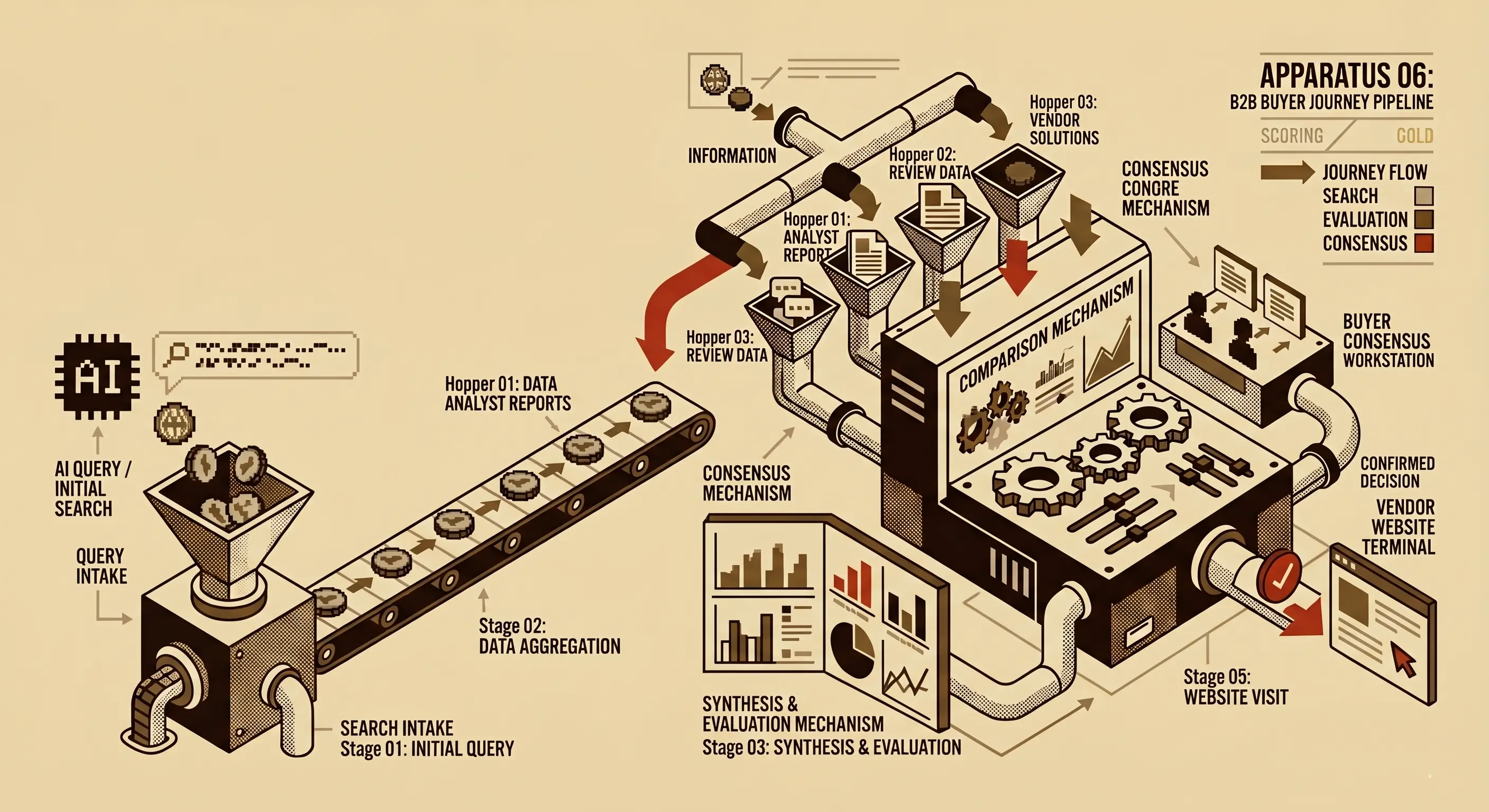
AI query first. The research starts with an AI assistant. ChatGPT, Perplexity, and Claude now field the questions that used to go to Google: what are the best options for X, who are the main vendors in Y space, what should I know about Z before buying. The buyer gets a synthesized overview in minutes. If you don’t appear in that answer, you don’t enter the consideration set.
Peer community second. After the AI gives them the landscape, they go looking for unfiltered opinions. Slack communities, Reddit threads, LinkedIn conversations, private forums: wherever the people who have already bought something like what you sell are talking candidly about their experience. This is the trust layer that vendor content cannot replicate.
Review platform third. G2, Capterra, and similar platforms get checked for pattern confirmation. Not to discover vendors (that happened in step one) but to look for consistent complaints, implementation patterns, and the gap between what a vendor claims and what buyers actually experienced.
LinkedIn fourth. They’re vetting the people, not the logo. Who runs marketing? What are they actually posting about? Is there a real point of view here, or just a profile that describes a job title? This is where thought leadership earns credibility or reveals its absence.
Your website last. By the time a buyer reaches your site, the decision is largely shaped. They’re there to confirm specifics: pricing approach, case studies, team background, whether your positioning matches what they’ve already heard about you. Discovery happened elsewhere.
Why nurture sequences miss the point
The email nurture sequence was built for a buyer who entered at awareness and needed educating over time. Feed them content, build familiarity, score their engagement, hand them to sales when the score hits a threshold.
That model made sense when buyers were early in their research when they first contacted you. It makes no sense for a buyer who has already completed their research, formed an opinion, and is now evaluating whether to take a call. Sending them a welcome sequence about the basics of a problem they spent an afternoon researching is not nurturing. It’s friction.
This is the Agency/SaaS Industrial Complex running on inertia: a system built for a buyer journey that no longer exists, still charging for the contacts in the sequence. The MQL the form fill generated was not an early-stage signal. It was a late-stage signal. The buyer who filled out the form had already decided you were worth a conversation. The nurture sequence treated them like they had just discovered you.
The confirmation role
If your website is a discovery layer, it needs comprehensive content, broad messaging, and clear category education. If it’s a confirmation layer, which it now is, it needs something different: clarity, specificity, and a point of view sharp enough to confirm or disqualify you quickly.
The questions a confirmation-stage buyer asks are not “what does this company do?” They are: does this company understand my specific problem? Do they have a position I can evaluate? Have they done this for a company like mine? Are these people credible?
Your pricing page matters more than your features page. Your case studies matter more than your product tour. A founder’s LinkedIn post about a specific, uncomfortable truth in your market matters more than your brand guidelines.
Clarity beats comprehensiveness for a buyer who already knows what they’re looking for. If your website requires ten minutes of reading to understand your position, the research-first buyer has already moved on.
What earns trust with this buyer
Trust with the research-first buyer is built before they contact you, in the channels they use during their research. Four things move the needle.
Specificity. Generic positioning signals that you work with anyone, which means you’ve probably not solved their specific problem before. Naming the exact type of company you work with and the exact problem you solve is a trust signal, not a constraint.
Point of view. The buyer checks LinkedIn and peer communities partly to see whether you have a perspective worth engaging with. A consistent, expressed point of view on how your market works, one that matches what they’ve already heard from peers, confirms credibility. The absence of one confirms nothing.
AI visibility in the right places. Showing up in AI-generated answers when buyers are forming their consideration set is no longer optional for B2B companies in competitive categories. If the AI assistant summarizing your space does not mention you, you are not in the early research.
Peer presence in the dark funnel. The community thread where someone asks for a vendor recommendation is worth more than most paid campaigns. Getting mentioned organically in the places your buyers trust requires being genuinely present in those spaces over time, not launching a one-off community seeding effort.
The buyer who already knows what they want is not harder to sell to. They’re easier, if you showed up correctly during the research phase.
If your best sales conversations start with buyers who already know your positioning, that’s not luck. It’s a model worth building deliberately.
The research phase is where that model gets built: the AI queries, the peer communities, the review platforms, the LinkedIn signal. Tangyslice helps lean tech companies show up in those places before first contact. If you want to understand what that looks like for your market, let’s talk.
Frequently asked questions
How has B2B buyer behavior changed in the last five years?
The research happened before you knew they existed. Five years ago, a buyer might enter your funnel early and let you walk them toward a decision. Today they've already consulted an AI, read the community threads, and checked your reviews before you have a contact record for them. First contact isn't the start of the journey. It's closer to the end.
What does the modern B2B buyer research process look like?
It runs in a consistent five-stage sequence: AI assistant for the market overview, peer community for unfiltered opinions, review platform to check the pattern of complaints, LinkedIn to vet the people behind the company, and your website last to confirm what they've already decided. Most of the decision-shaping happens before a buyer ever visits your site.
Why don't email nurture sequences work for today's B2B buyers?
Because today's buyers do the nurturing themselves. A research-first buyer who fills out your form has already spent an afternoon learning about the problem, the landscape, and your competitors. Sending them an awareness-stage email sequence is not meeting them where they are. It's treating someone who just handed you a letter of intent like they've never heard of you.
What do B2B buyers look for before a sales call?
Confirmation, not discovery. By the time they book the call, the question isn't 'what does this company do?' It's 'are these the right people for our specific problem?' Pricing transparency, case studies for comparable companies, and a visible point of view answer that question. A features page does not.
How are B2B buyers using AI in their purchase research?
As a first-pass filter. Instead of sifting through vendor blogs and analyst reports, they ask ChatGPT, Perplexity, or Claude to synthesize the landscape in sixty seconds. The AI tells them who the main players are, what differentiates them, and what to watch out for. If you're not in that answer, you don't make the consideration set. The evaluation starts without you.
What content earns trust with research-first B2B buyers?
Content that is specific, opinionated, and demonstrably human. Generic positioning signals that you work with anyone, which reads as code for not having solved their specific problem before. What actually earns trust is a clear point of view on the market, case studies from companies that look like them, and a visible presence in the peer communities where their peers talk. Thought leadership that says something is worth more than content that covers everything.
Work with us
Ready to get out of the complex?
We work with lean SMB tech teams that are done optimizing the old model. Let's find out if there's a fit.
Let's talk →